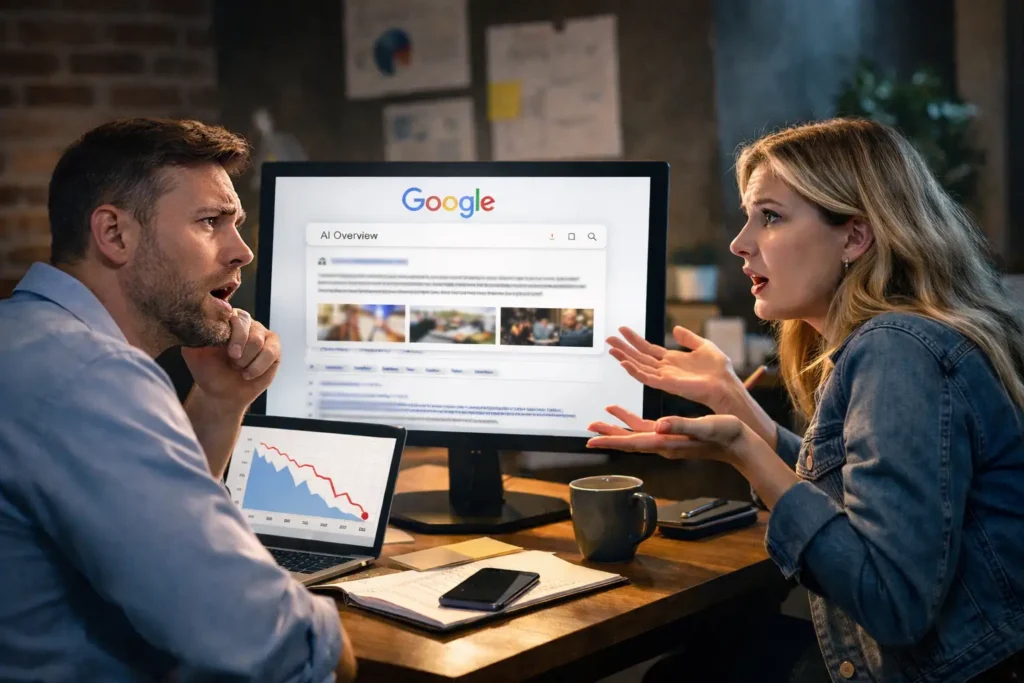
If you’ve searched anything on Google lately, you’ve probably noticed something new sitting comfortably at the top of the page — the AI Overview. It’s like that overachieving student who raises their hand before the teacher even finishes asking the question. But why did Google introduce it? Is it actually helpful, or just showing off?
Let’s break it down in a way that makes sense.
The Evolution of Search – From Links to Answers
Once upon a time, search engines were glorified directories. You typed something in, and they gave you a list of links. That was it. No explanations, no summaries, just a digital version of “go figure it out yourself.”
Over time, Google got smarter. It started understanding intent, context, and even your late-night questionable searches. Then came featured snippets — those little boxes that tried to answer your question directly.
AI Overview is simply the next step in this evolution. Instead of giving you one small answer or ten blue links, Google now tries to give you a complete, structured response instantly.
Think of it like upgrading from a map to a personal tour guide.
Why Google Introduced AI Overview
There isn’t just one reason — there are several, and they all tie back to how people behave online.
First, users want speed. Nobody wants to open five tabs just to figure out how to boil an egg or understand a tax concept. AI Overview reduces friction by summarizing everything in one place.
Second, competition is heating up. Tools like ChatGPT changed user expectations. People now expect conversational answers, not just links. Google had to adapt or risk becoming the “old-school option.”
Third, data control. By generating answers directly, Google keeps users on its platform longer. More time on Google means more opportunities for ads, engagement, and data insights.
So yes — it’s helpful, but it’s also a strategic business move.
How AI Overview Actually Works
At its core, AI Overview uses advanced machine learning models — similar to large language models — to analyze content from across the web and generate a concise response.
It doesn’t just copy one source. Instead, it blends information from multiple pages, looking for patterns, agreements, and relevance.
Here’s a simplified breakdown:
- It scans top-ranking pages
- Extracts key information
- Cross-checks consistency
- Generates a human-like summary
Sounds impressive — and it is — but it’s not perfect.
Sometimes it confidently gives incorrect answers, which is both fascinating and slightly terrifying. Imagine a very confident intern who occasionally makes things up.
What This Means for SEO
Now we get to the part that actually matters for businesses.
AI Overview is changing how visibility works. Ranking #1 is no longer the ultimate goal — because even if you rank first, users might never click your site if the AI already answered their question.
That means SEO is shifting from “get clicks” to “be the source of the answer.”
To stay relevant, websites need to:
- Provide clear, structured content
- Demonstrate expertise and trust
- Answer questions directly and efficiently
- Build authority across their niche
This is where working with professionals becomes critical. A strong local marketing agency in Calgary understands how to adapt strategies to these changes instead of guessing and hoping for the best.
The Hidden Impact on Businesses
AI Overview isn’t just a technical update — it’s a behavioral shift.
Users are becoming more passive. Instead of exploring multiple sources, they rely on one summarized answer. That reduces website traffic for many businesses, especially those relying on informational content.
But there’s another side to this.
If your content is used in the AI Overview, your brand gains visibility and credibility. You become part of the “trusted pool” Google pulls from.
It’s like being quoted in a news article — you might not get all the clicks, but you gain authority.
Still, getting into that pool is not random. It requires strategy, consistency, and technical precision — things that most business owners don’t have time to master themselves.
AI Overview vs Traditional Search – Who Wins?
This isn’t a battle where one replaces the other. Instead, they coexist.
Traditional search still matters for:
- Transactional queries (buying, booking, comparing)
- Local searches
- Detailed research
AI Overview shines in:
- Quick answers
- Definitions
- General knowledge
So rather than asking “which one wins,” the better question is — how do you show up in both?
That’s where advanced optimization comes into play. Professional Calgary SEO services focus on positioning your business across multiple layers of search, not just rankings.
The Future of Search – Where This Is All Going
AI Overview is just the beginning. Search is moving toward a fully conversational experience where users interact with AI instead of browsing pages.
Imagine asking a question, refining it, and getting increasingly personalized answers — all without leaving the search page.
Convenient? Absolutely.
Risky for businesses? Also yes.
Because the more Google answers directly, the less users need to visit websites.
That means brands must evolve from “content creators” to “authority sources.” It’s no longer enough to write articles — you need to be the best, most reliable source of information in your niche.
Should You Be Worried?
Short answer — not worried, but definitely paying attention.
AI Overview rewards high-quality content and punishes weak, generic pages. If your website is well-optimized, authoritative, and genuinely useful, this update can actually work in your favor.
If not, it can quietly erase your visibility.
That’s why guessing your way through SEO is no longer a viable strategy. The margin for error is shrinking, and the competition is getting smarter.
Final Thoughts – Adapt or Get Left Behind
Google didn’t create AI Overview just to look cool — it did it because user behavior changed, and technology made it possible.
For businesses, this is a turning point.
Search is no longer about being found — it’s about being chosen by the algorithm as a trusted source.
And that requires more than basic optimization. It requires a clear strategy, deep understanding, and continuous adaptation.
The companies that embrace this shift will dominate their markets. The ones that ignore it will slowly fade into digital silence.
The question is — which side do you want to be on?