Quick answer: If your Google Business Profile (GBP) is showing fewer calls, clicks, or direction requests than last year, it doesn’t automatically mean fewer people are finding your business.
Google’s search results have gotten more crowded as more customers are getting what they need right on the results page without clicking anything.
- With Ads, and
- AI-generated answers
A real decline is possible too but the GBP performance dashboard alone can’t tell you which one it is. This article walks through both possibilities so you know what to check next.
Lower numbers on your GBP dashboard don’t always mean lower demand for your business. Google’s search results and the way people use them have changed a lot since the mass use of AI platforms.
Before you overhaul your marketing, it’s worth understanding what these numbers actually measure and where any real decline might be happening.
What Does “Declining GBP Performance” Actually Mean?
Your Google Business Profile performance report tracks two different things: visibility (how many people saw your profile) and interactions (what they did after seeing it — calling, clicking your website, requesting directions, or booking).
Here’s the part most business owners don’t realize: Google counts a “call” as someone tapping the call button on your profile. It has no way of knowing whether that call was answered, how long it lasted, or whether it turned into a customer. Someone could also find your business on Google, remember the name, and contact you a day later by typing your number directly — which shows up nowhere in your GBP report.
So the first question isn’t “why is my Google Business Profile failing?” It’s:
Are we actually losing visibility, or are customers just interacting with our listing differently than they used to?
Google’s own Business Profile performance documentation confirms this distinction. Profile views count unique visitors, and calls only count clicks on the call button, not completed conversations. That distinction matters a lot when you’re comparing one year to the next.
Why Are Google Search Results More Crowded Now?
A customer searching for your services today typically sees several things before they ever reach your listing:
- Local Services Ads — a paid ad format with a green check mark that appears above regular map results, mainly used by home service and professional businesses
- Regular search ads — standard paid listings marked “Sponsored”
- AI-generated answers — Google’s AI summarizes an answer directly on the results page (more on this below)
- Directories and comparison sites — Yelp, industry-specific directories, and similar sites
On a phone screen, all of this pushes the traditional map results further down, past the scroll. Your business can hold the exact same ranking position it had last year and still get fewer clicks, simply because there’s more competing for attention above it.
This isn’t a small, isolated pattern. One industry analysis, Sterling Sky’s State of Local SEO report, tracked declining click-to-call activity across law firm profiles even where rankings hadn’t dropped, a useful illustration, though it’s one industry sample and not a guarantee of what’s happening on your profile specifically.
EXAMPLE: Here is a screenshot of what you see when searching for – Calgary Corporate Lawyers
As of today, this search query is still not showing an AI overview.
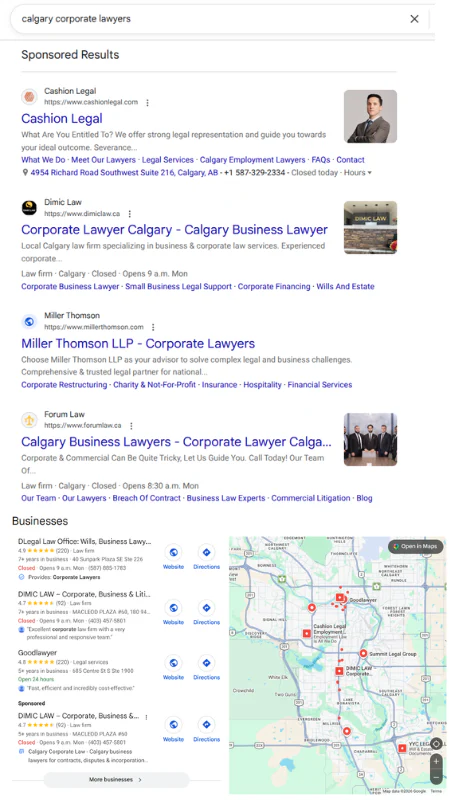
BUT if you change your search query to: Recommend a good corporate lawyer in Calgary – you will get an AI overview answer first giving you options right there of just 3-4 lawyers whose website is optimized for AI. Many people will not search any further…and this is a problem if your business is not the one showing up on top, in AI overview.
TAKEAWAY: Ask your digital marketing agency to optimize your website for AI
Why Are Fewer Searches Turning Into Website Clicks?
Google increasingly answers questions directly in the search results — hours, services, reviews, and photos can all be visible without a single click to your website. AI-generated answer boxes (often called AI Overviews) add another layer, summarizing information from multiple sources into one block at the top of the page.
Research from Pew Research Center found that people clicked through to a traditional website result far less often on searches where an AI summary appeared, compared to searches without one. That study covered general Google searches rather than GBP traffic specifically, but it points to the same shift: Google is answering more questions before the customer ever clicks anything.
That’s not automatically bad news. A customer who already read your reviews, confirmed your hours, and checked your services before contacting you is often a better lead — more informed and further along than someone clicking blind. It’s one more reason to look at lead quality and revenue alongside raw click counts, not instead of them.
Curious how this AI-answers shift works in more detail? We’ve broken it down separately in our blog posts:
What Google AI Overview and SGE actually are
and
How to optimize for Google AI Overviews.
Are Customers Searching for You Differently Now?
The short answer is: Yes.
Search queries are getting longer and more conversational.
Instead of typing “Calgary chiropractor,” someone might type or speak, “who treats lower back pain near me and has openings this week.”
People also bounce between Google Search, Google Maps, AI assistants, and social platforms before deciding who to contact.
A profile optimized only for a few broad keywords can miss these more specific, natural-language searches.
Google has said local rankings come down to three main factors:
- relevance (how well your business matches what was searched),
- distance (how close you are to the searcher), and
- prominence (how established and well-reviewed your business appears online).
This also means there is no single, fixed ranking for your business. You might be highly visible in one neighborhood and nearly invisible a few kilometres away. This is why local SEO usually needs to be checked from multiple locations, not just your own office.
Could Competitors or Changing Demand Be the Real Reason?
Two non-Google explanations are worth ruling out before you assume the platform is at fault:
Your competitors got better. More businesses are actively collecting reviews, keeping their listings accurate, and building local authority.
If competitors improved while your profile stayed static, your share of visibility can shrink even though you didn’t do anything differently. If a specific competitor now consistently outranks you, that’s worth investigating directly. See why a competitor might be ranking higher than you.
Demand itself shifted. Weather, seasonality, interest rates, and household budgets all move local search volume independently of anything on your profile. A roofing company shouldn’t compare call volume from a quiet season against an unusually active storm year without accounting for that gap.
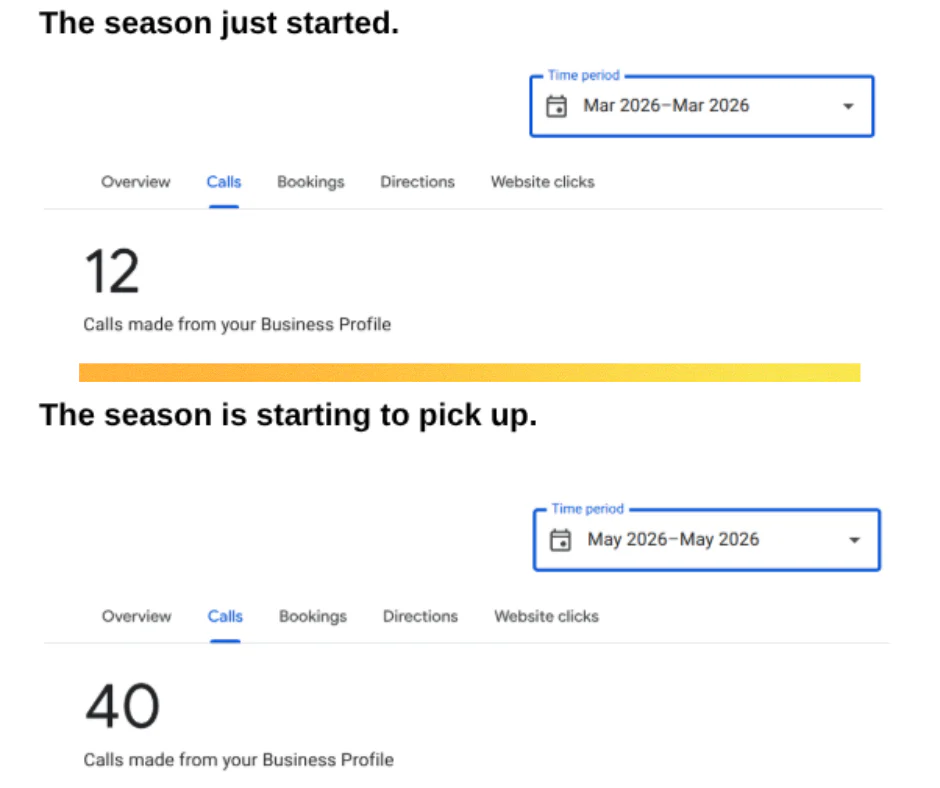
Online traffic volume changes with seasons. Most industries have busier seasons and slow seasons that repeat year after year no matter how digital marketing changes.
EXAMPLE:
A roofing company’s Google Business Profile – Calls search volume in Calgary is much less in the colder months than in late spring or summer.
When Is a Decline a Real Warning Sign?
Not every dip can be explained by Google’s changing layout. It’s worth digging deeper when you notice:
- Weaker visibility for valuable, non-branded searches (searches that don’t include your business name)
- Falling map rankings across several parts of your service area, not just one search location
- Declining leads across every channel — GBP, website, ads — not just GBP
- Incorrect categories, hours, services, or contact details on your profile
- Fewer recent reviews, or a rating trending downward
- A slow-loading or hard-to-use website, especially on mobile
- A specific competitor consistently outranking you
If several of these apply, the decline is more likely a real issue than a Google layout shift. That’s also often where a website isn’t generating leads even when it’s getting some traffic, or a business finds it’s not showing up in Google Search at all for the searches that matter most.
How Do You Find Out What’s Really Going On?
Start by comparing identical date ranges year over year (including the same number of weekdays and weekends) and look at profile views, calls, website clicks, bookings, and direction requests separately rather than as one combined total.
From there, a full picture usually means cross-checking GBP against:
- Actual call volume from your phone system or a call-tracking tool (not just GBP’s click count)
- Website sessions and conversions in an analytics platform
- Search impressions and clicks in Google’s own search reporting tool
- Completed forms, booked appointments, and qualified leads — the numbers that actually reflect revenue
- Local rankings checked from several neighborhoods, not just one
- Branded searches (people searching your business name) versus service searches (people searching what you do)
This is genuinely a lot to track and cross-reference correctly.
Google’s own performance data has real limitations, and it’s easy to draw the wrong conclusion from a single graph. It’s exactly the kind of diagnostic work an agency handles day-to-day
Our free website audit is a straightforward way to get a second, expert set of eyes on it without committing to anything.
The Bottom Line: Qualified Leads Matter More Than Raw Clicks
Google Business Profile is still an important part of local visibility, but its dashboard was never designed to tell the whole story. Search layout changes, AI-generated answers, shifting customer behavior, competition, and seasonal demand can all reduce measurable profile actions without reflecting a real drop in business.
A year-over-year decline deserves a closer look — but it’s the start of an investigation, not proof your marketing has stopped working.
Frequently Asked Questions
Does a drop in Google Business Profile calls mean I’ve lost customers? Not necessarily. GBP only counts clicks on the call button, not completed calls or their outcome. Customers who call you a different way, or contact you later from memory, won’t show up in this number at all.
Why do I see fewer website clicks from my GBP listing than I used to? Google increasingly displays hours, reviews, services, and photos directly in the search results, so customers can get what they need without clicking through. AI-generated answer summaries add to this effect.
How often should I check my Google Business Profile performance? Monthly is usually enough to spot trends without overreacting to normal week-to-week noise. Compare the same date ranges year over year rather than just looking at the last 30 days in isolation.
Could my Google Business Profile decline be caused by something I can fix? Yes — outdated categories, hours, or services, a thinning stream of recent reviews, or a slow mobile website are all common, fixable causes worth ruling out first.
Concerned about declining Google Business Profile results?
for a practical review of your local visibility, website traffic, and lead activity
or start with our free website audit.