Google has quietly changed the rules of the game.
Instead of sending users to ten different websites, it now answers questions directly through AI Overview — a smart summary built from multiple sources. It feels fast, convenient, and slightly unfair to everyone who spent years fighting for page-one rankings.
So here’s the real challenge:
How do you become one of the sources Google’s AI chooses?
Let’s break it down step by step — with practical logic, real-world examples, and zero fluff.
What AI Overview Actually Wants From Your Content
AI Overview doesn’t rank pages the same way traditional search does. It doesn’t just look for keywords — it looks for answers.
But not just any answers. It wants:
- Clear, structured explanations
- Content that solves a specific problem
- Information that feels trustworthy and complete
For example, instead of writing something vague like:
- “Legal services for businesses”
A better approach would be:
- “What should a small business do before signing a contract with a lawyer?”
Or instead of:
- “Accounting services overview”
Try:
- “How does a small business prepare financial statements for tax season?”
This is how real users search — and this is exactly what AI Overview is built to understand.
Step 1 – Think Like a Human Asking a Question
The foundation is simple: your content must match how people actually think.
Users don’t search like robots. They ask:
- “Do I need a lawyer for this?”
- “How much does bookkeeping cost?”
- “What happens if I miss a tax deadline?”
Your job is to:
- Identify these questions
- Answer them directly
- Keep the tone natural and easy to follow
If your content feels like a real conversation, AI is far more likely to trust it.
Step 2 – Structure Is Everything
Even great content can fail if it’s hard to read.
AI Overview prefers content that is:
- Clearly divided into sections
- Easy to scan
- Built around questions and answers
The ideal structure looks like this:
- Question
- Short, direct answer
- Expanded explanation
This format makes it extremely easy for AI to extract and summarize your content.
Step 3 – Depth Beats Surface-Level Content
AI isn’t looking for quick definitions — it wants full understanding.
If you’re writing about legal advice, don’t stop at:
- “A contract is a legal agreement”
Go further:
- When is it required?
- What are common mistakes?
- What risks should you avoid?
The more complete your content is, the more valuable it becomes.
Step 4 – Authority Still Matters (A Lot)
This is where many people misunderstand AI Overview.
Yes, AI summarizes content.
But it still relies on trusted sources.
To build authority:
- Show real expertise (case examples, scenarios)
- Add author credibility
- Use precise, confident explanations
A well-established SEO company in Calgary that consistently publishes high-quality insights has a much stronger chance of being featured than a random new blog.
Step 5 – Simplicity Wins Over Complexity
Here’s a counterintuitive truth:
The smarter Google gets, the simpler your writing should be.
Avoid:
- Overcomplicated sentences
- Industry jargon without explanation
- Long, confusing paragraphs
Instead:
- Keep sentences clear
- Use everyday language
- Guide the reader step by step
If your content is easy to understand, it’s easy for AI to use.
Step 6 – Use Real Examples That Reflect Reality
Generic content doesn’t stand out.
Instead of saying:
- “Hiring a lawyer is important”
Explain:
- “If a business signs a contract without reviewing liability clauses, it can face unexpected financial risks later.”
Instead of:
- “Accounting is essential”
Explain:
- “Missing tax deadlines can lead to penalties, which is why many businesses hire professionals to manage reporting.”
Real-world examples build trust — and trust is what AI looks for.
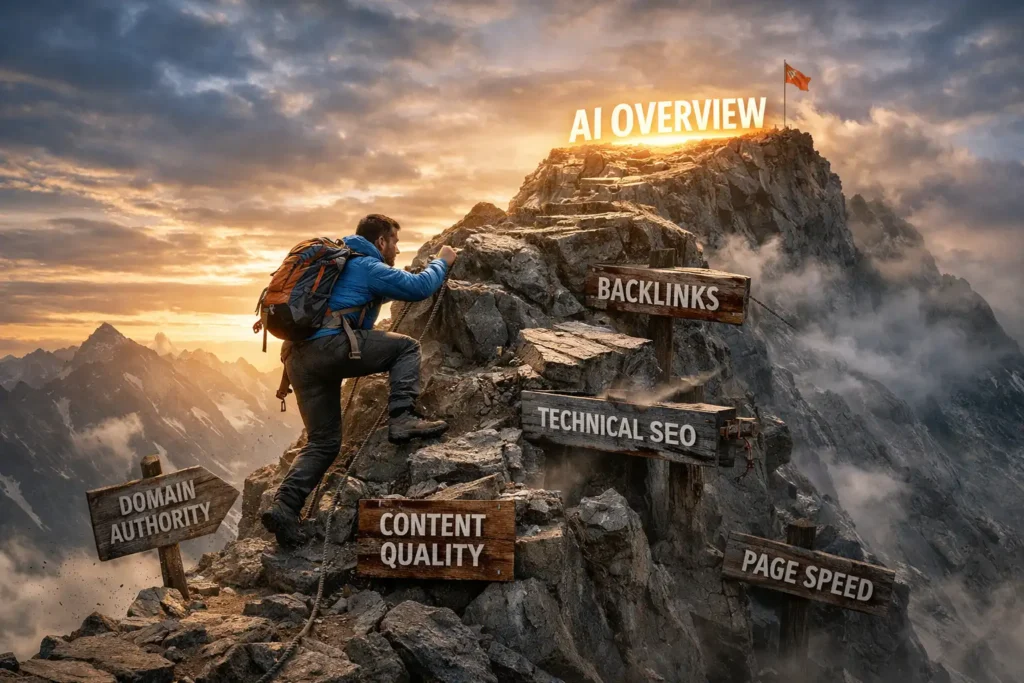
Step 7 – Technical SEO Still Supports Everything
Even the best content won’t perform if your website is broken.
Make sure:
- Pages load fast
- The site works on mobile
- Content is properly indexed
- There are no major technical errors
Technical SEO doesn’t make you rank by itself — but without it, nothing else works.
Step 8 – Off-Site Signals Build Trust
AI doesn’t evaluate your content in isolation.
It looks at your overall reputation:
- Are other websites referencing you?
- Is your brand mentioned online?
- Do you have backlinks from credible sources?
If the answer is no, your chances drop significantly.
This is why a strong digital marketing company in Calgary focuses not only on content, but also on authority building across the web.
Step 9 – Content Is a Living System
Publishing once is not enough.
To stay competitive:
- Update your content regularly
- Expand it with new questions
- Improve clarity and depth over time
AI prefers content that evolves — not content that sits untouched for years.
Step 10 – The Truth Most People Ignore: Classic SEO Still Decides Everything
This is the part many people don’t want to hear — but it’s the most important one.
Imagine this scenario:
Someone launches a brand-new website yesterday.
They do everything “right” for AI:
- Write content in a Q&A format
- Add structured headings
- Include an author
- Fully answer the topic
And yet… nothing happens.
Why?
Because AI Overview doesn’t operate in a vacuum.
It builds answers from sources that already have credibility in Google’s ecosystem.
That means:
- Domain age matters
- Website size matters (more pages, more coverage)
- Consistent blogging matters
- Backlinks matter
- Overall rankings matter
In reality, most sources featured in AI Overview are already ranking somewhere on page one — or close to it.
So even if your content is perfectly optimized for AI:
- If your site has no history
- No authority
- No visibility
You are extremely unlikely to be selected.
This is where traditional SEO becomes critical:
- Building topical authority over time
- Publishing large amounts of valuable content
- Earning trust through links and mentions
- Growing your presence steadily
AI Overview is not replacing SEO.
It is sitting on top of it.
Why Professional Strategy Wins
At this point, it becomes clear:
Ranking in AI Overview is not about one trick.
It’s about combining:
- Content strategy
- Technical optimization
- Authority building
- Long-term SEO growth
Trying to manage all of this without experience often leads to slow or invisible results.
That’s why businesses that work with experienced teams tend to move faster, avoid costly mistakes, and build sustainable visibility.
Final Thoughts – Visibility Now Belongs to the Prepared
AI Overview is not the future — it’s already here.
To succeed, you need to:
- Understand how users ask questions
- Deliver clear and structured answers
- Build real authority over time
- Combine AI-focused content with classic SEO
Those who adapt early gain a massive advantage.
Those who ignore it risk becoming invisible — even if their content is “good.”
And in a world where Google answers the question before the user even clicks…
being part of that answer is the ultimate position to win.