Search engine optimization has always been a bit like cooking. You take ingredients – keywords, backlinks, content – mix them carefully, wait patiently, and hope Google doesn’t suddenly change the recipe overnight. Now imagine someone hands you a robot chef that claims it can cook faster, smarter, and maybe even tastier. That’s exactly what’s happening with AI SEO.
So, is AI the ultimate upgrade, or just another shiny gadget that burns your digital soufflé? Let’s break it down in a way that actually makes sense.
What Is Traditional SEO – The Old-School Playbook
Traditional SEO is the foundation. It’s what built the internet as we know it today. Think keyword research, on-page optimization, link building, and technical fixes. It’s manual, structured, and often… slow.
Professionals spend hours analyzing search intent, optimizing meta tags, fixing site speed issues, and crafting content that both users and search engines love. It works – and it works well – but it requires experience, patience, and consistency.
The biggest strength of traditional SEO is control. You know what you’re doing, why you’re doing it, and how it affects rankings. But the downside? It’s time-consuming, and if you’re doing it alone, it can feel like assembling IKEA furniture without instructions.
What Is AI SEO – The New Kid With Superpowers
AI SEO is like giving that same IKEA project to someone with a power drill, blueprint scanner, and caffeine-fueled motivation. It uses machine learning tools to automate tasks, analyze data faster, and generate content at scale.
AI can:
- Generate content ideas in seconds
- Analyze competitors instantly
- Predict keyword trends
- Optimize content automatically
Sounds impressive, right? It is. But there’s a catch.
AI doesn’t understand your business the way a human does. It processes patterns, not emotions, brand voice, or real-world nuance. So while it can produce a lot, it doesn’t always produce quality that converts.
Speed vs Strategy – The Real Difference
Here’s where things get interesting.
AI SEO is fast. Very fast. It can create 20 blog drafts before your morning coffee is ready. Traditional SEO, on the other hand, is slower but more strategic.
Think of it like this:
- AI SEO = quantity and speed
- Traditional SEO = quality and depth
The magic happens when both are used together. AI can handle repetitive tasks, while humans focus on strategy, creativity, and decision-making.
That’s why businesses working with an experienced internet marketing company in Calgary often see better results – they don’t rely on just one approach. They combine tools with expertise.
Content Creation – Human vs Machine
Content is still king. But now the king has a robot assistant.
AI can write articles, product descriptions, and even landing pages. But if you’ve ever read pure AI-generated content, you might notice something… off. It’s technically correct, but it lacks personality, humor, and real engagement.
Humans bring:
- Storytelling
- Brand voice
- Emotional connection
AI brings:
- Speed
- Structure
- Data-driven optimization
The best content today? It’s hybrid. AI helps draft and structure, while humans refine, inject personality, and make it actually enjoyable to read – like this article.
Google’s Perspective – What Actually Ranks?
Google doesn’t care if your content is written by a human or AI. What it cares about is quality, relevance, and user experience.
This is where many people get it wrong. They assume AI can “game the system.” It can’t – at least not for long.
Search engines reward:
- Helpful content
- Clear structure
- Authority and trust
- Real user engagement
Spammy AI content might rank briefly, but it won’t last. Sustainable rankings come from strategy, not shortcuts.
That’s why professional search engine optimization in Calgary services focus on long-term growth rather than quick wins that disappear after the next algorithm update.
Technical SEO – Where AI Really Shines
If there’s one area where AI truly dominates, it’s technical SEO.
AI tools can:
- Crawl your site instantly
- Detect errors faster than any human
- Suggest improvements in real time
Things like broken links, page speed issues, and indexing problems are handled much more efficiently with AI support.
But again – interpretation matters. AI can tell you what’s wrong, but a professional knows what matters most and what to fix first.
The Cost Factor – Cheap vs Smart Investment
AI tools often look cheaper upfront. Subscription, click a few buttons, done.
But here’s the reality:
- Poor strategy = wasted traffic
- Weak content = low conversions
- No expertise = missed opportunities
Doing everything yourself might save money in the short term, but it often costs more in lost growth.
Working with professionals means you’re not just buying tools – you’re buying experience, strategy, and results.
Is Traditional SEO Becoming Obsolete – Or Just Evolving?
After everything you’ve read so far, it might start to feel like AI SEO is the ultimate winner – faster, smarter, more efficient, and when guided by professionals, almost unstoppable. And yes, when used correctly, it really does feel like everything “just works.”
But let’s pause for a second. Because what we’ve been talking about this whole time – keywords, content, structure, search intent – that’s traditional SEO. So the real question is: does that mean all of this is now outdated and can be ignored?
Not even close.
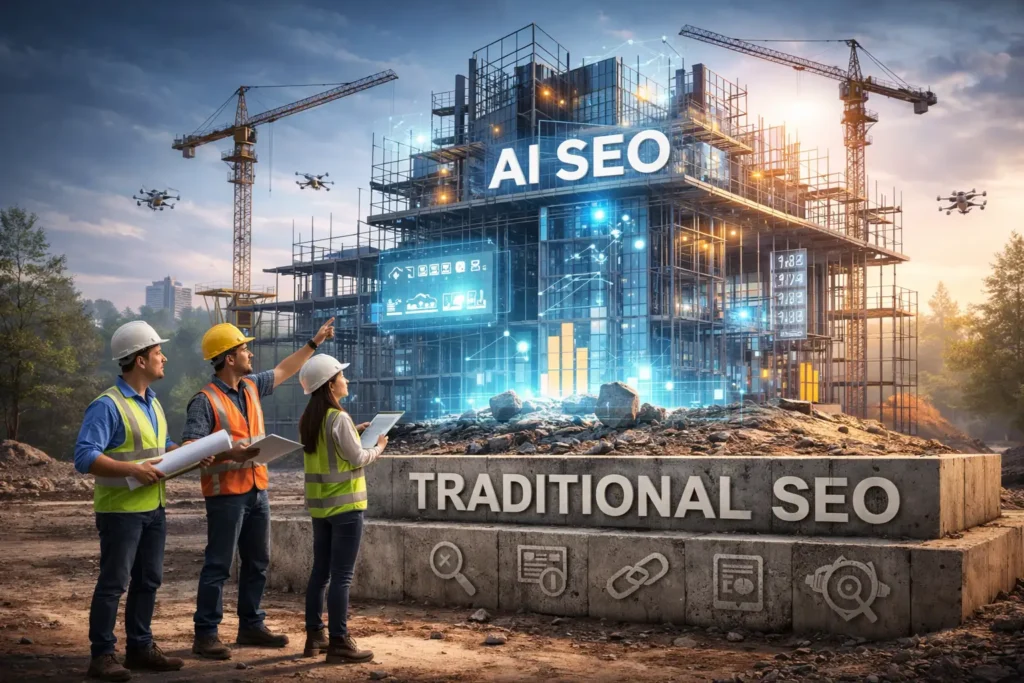
What’s actually happening is a shift in role, not relevance. Traditional SEO hasn’t disappeared – it has become the foundation of everything that AI SEO builds on. Think of it less as a complete system and more as the base layer that supports the entire structure.
AI doesn’t magically replace keyword research – it accelerates it. It doesn’t eliminate content strategy – it depends on it. It doesn’t remove the need for proper site structure – it assumes it’s already there.
In other words, AI SEO without traditional SEO is like trying to build a house in mid-air.
Can you technically do it? Maybe. With enough tools, hacks, and temporary support, something might stand. But how long will it last? A day? A week? Until the next Google update comes along and everything collapses?
That’s the reality.
Traditional SEO – semantic core, keyword clustering, internal linking, content depth, technical hygiene – is what gives your website stability. It’s what tells search engines who you are, what you offer, and why you deserve to rank.
AI then comes in and builds on top of that foundation:
- Scaling content production
- Enhancing optimization
- Identifying opportunities faster
- Automating repetitive processes
But without a solid base, all of that power becomes unstable.
This is where many businesses make a critical mistake. They jump straight into AI tools, generate massive amounts of content, and expect results. But without structure and strategy underneath, it’s like pouring concrete on sand.
The strongest digital strategies today don’t replace traditional SEO – they elevate it.
They take everything that already works:
- Well-researched keywords
- Properly structured pages
- Valuable, user-focused content
And then amplify it using AI.
So no, traditional SEO is not something you “skip” or “replace.” It’s something you build first, carefully and correctly. Because the stronger your foundation, the higher and more stable your entire SEO structure can grow.
And when this foundation is combined with AI under the guidance of experienced professionals, that’s when things don’t just work – they scale, grow, and dominate consistently.
So… Who Wins?
AI SEO vs Traditional SEO isn’t really a fight. It’s a partnership.
AI is the engine.
Traditional SEO is the driver.
Without AI, you’re slower.
Without strategy, you’re lost.
The real winners are businesses that combine both – using AI for efficiency and human expertise for direction.
Final Thoughts – Don’t Just Follow Trends, Use Them Wisely
AI is not replacing SEO professionals. It’s changing how they work.
The smartest approach isn’t choosing one over the other. It’s leveraging both in a way that actually grows your business. Because at the end of the day, rankings are great – but revenue is better.
And while experimenting with AI tools can be exciting, building a strong, scalable online presence usually requires more than just software. It takes experience, testing, and a clear strategy.
That’s where working with the right team makes all the difference – turning complex SEO into something that feels, well… effortless.